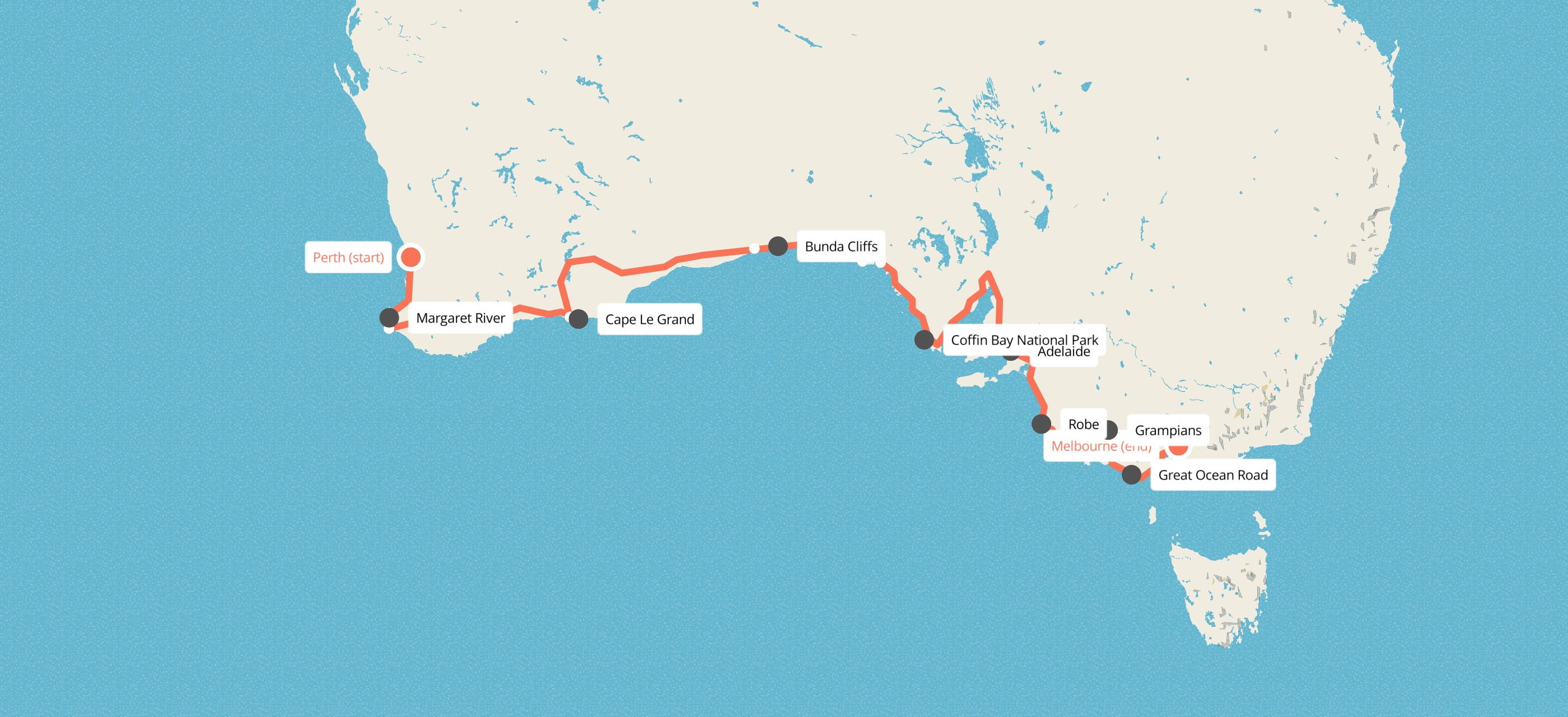
Map
DAY 1: PERTH TO DUNSBOROUGH AND EAGLE BAY
Meet in Perth in the morning for the handover, get to know your trip mates and do a big food shop for the week ahead. This is a shared rental, so the route below is the recommended plan and your group can change it. Then head south to Dunsborough and Eagle Bay on Geographe Bay, named in 1801 by the French navigator Nicolas Baudin after his ship. The beaches here have calm, clear water and white sand. Don't miss the Natural Spa at Injidup, a rock pool where waves pour over a granite ledge and turn the water to foam, and grab an ice cream at Simmo's in Dunsborough.
DAYS 2-3: MARGARET RIVER AND HAMELIN BAY
Spend two days around Margaret River, a region known for food, wine and surf, where the first commercial vineyard was planted in 1967. Try a few cellar doors, or if wine isn't your thing, there are cheese and chocolate tastings. Down the coast at Hamelin Bay, stingrays and eagle rays glide into the shallows beside the remains of an old timber jetty, close enough to reach out to. They're wild animals, so give them room to come to you.
DAY 4: PEMBERTON AND THE KARRI FOREST
Turn inland into the forest around Pemberton, full of karri trees that grow up to 90 metres tall, among the tallest hardwoods in the world. Fire spotters once kept watch from cabins built in their crowns. The most famous is the Gloucester Tree, where 153 metal pegs spiral up the trunk to the lookout near the top. It's a little scary and well worth it. Back on the ground there's a dam, cascades and plenty of forest walks nearby.
DAY 5: WALPOLE AND DENMARK
In Walpole, the Valley of the Giants Tree Top Walk takes you 40 metres up into the crowns of red tingle trees, which grow only in this small corner of the south coast. There are free forest walks nearby too. Then carry on to Denmark, a timber town in the 1890s and now a laid-back, artsy place. At Ocean Beach, where the Wilson Inlet meets the Southern Ocean, you can surf. Greens Pool is sheltered by a ring of granite boulders and calm enough to swim on most days, and a short walk away the huge rounded Elephant Rocks look like a herd wading into the sea.
DAYS 6-7: ALBANY AND THE GREAT SOUTHERN
Albany is the biggest town you'll see for quite a while, so stock up on groceries. Founded in 1826, it was the first European settlement in Western Australia, and the first Anzac convoys sailed from its harbour in 1914. Just out of town, Torndirrup National Park has The Gap, where the Southern Ocean surges into a granite chasm, and the rock arch of the Natural Bridge. Inland you can hike the Porongurup Range to the Granite Skywalk on Castle Rock, or detour to Bluff Knoll, at 1,099 metres the highest peak in the Stirling Range and one of the few places in Western Australia that sometimes sees snow.
DAY 8: FITZGERALD RIVER NATIONAL PARK
East of Albany, Fitzgerald River National Park stretches along the coast towards Esperance. It is one of the richest places for plants in Australia, home to wildflowers found nowhere else, such as the royal hakea with its orange and red leaves. The park has swimming and fishing beaches, rocky sea cliffs, calm inlets and walks both steep and easy. The best hike climbs East Mount Barren, a quartzite peak with views over the ocean and the heath, and there are snorkelling spots along the shore.
DAYS 9-10: ESPERANCE AND CAPE LE GRAND
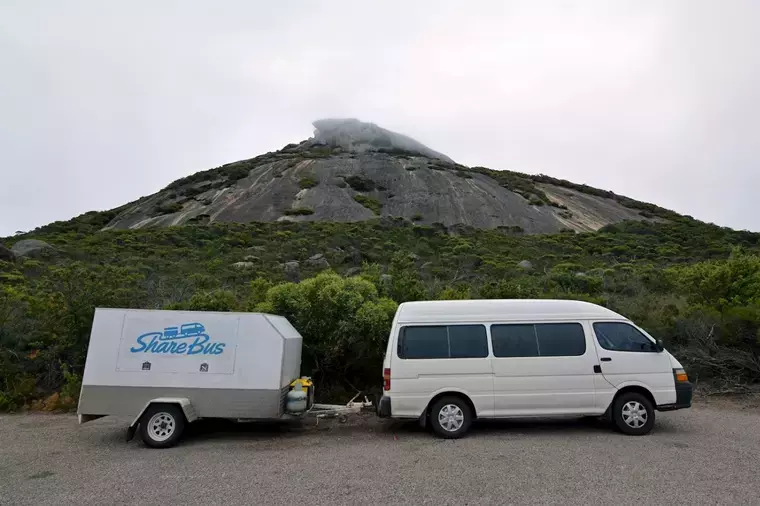
This part of the trip is often the highlight. Esperance takes its name from the French ship Espérance, which sheltered here in 1792, and its beaches are the ones in all the photos of bright white sand and kangaroos. In Cape Le Grand National Park, head for Lucky Bay, named by Matthew Flinders in 1802 when it gave his ship shelter from a storm. Kangaroos really do laze on the sand here. For a view, climb Frenchman Peak, a granite dome with a wind-carved cave near the top. There are many more beaches, all with white sand and clear blue water.
DAY 11: NORSEMAN AND THE START OF THE NULLARBOR
Today you start the crossing of the Nullarbor. Ease in with a stop at Norseman, the official start of the crossing, a mining town named after a horse called Norseman, said to have turned up a nugget of gold with its hoof in 1894. It has a few things to see and, best of all, a free swimming pool. Then head east along the Eyre Highway to get a head start on the Nullarbor Plain, whose name is Latin for "no tree". Pull up at a free camp and enjoy your first evening under outback stars.
DAY 12: ACROSS THE NULLARBOR
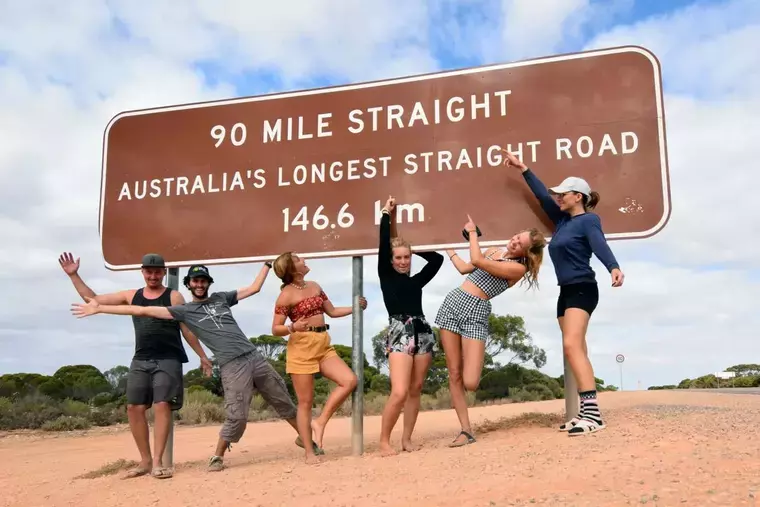
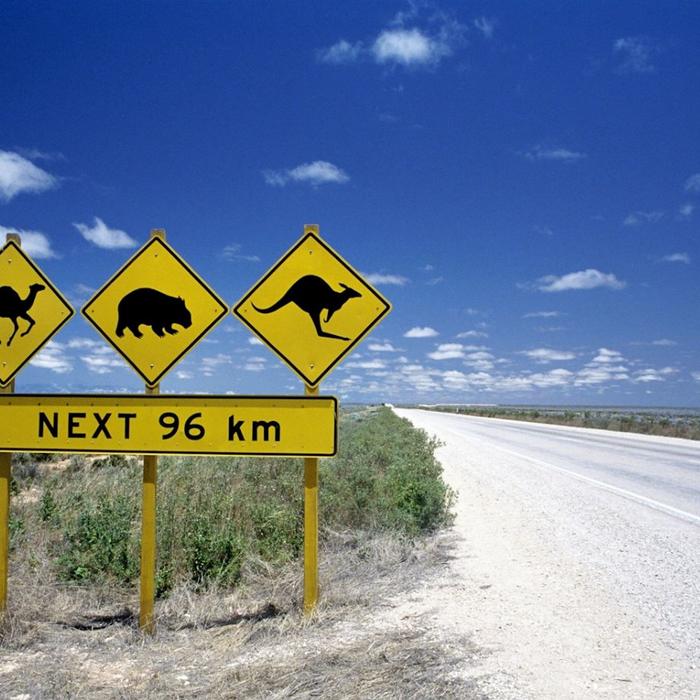
Some serious driving begins. Stop at the roadhouse towns along the way: Balladonia, where pieces of the Skylab space station fell to earth in 1979, then the 90 Mile Straight to Caiguna, at 146.6 km the longest straight stretch of road in Australia, and Cocklebiddy, which sits above one of the longest underwater caves in the world. Madura has a lookout over the plain and a camp, or if you're up for the drive you can push on to Eucla, where the ruins of the 1877 telegraph station are slowly being buried by sand dunes, and the old jetty still reaches out from the beach.
Overnight: Madura or Eucla (camping)
DAY 13: EUCLA TO CACTUS BEACH AND CEDUNA
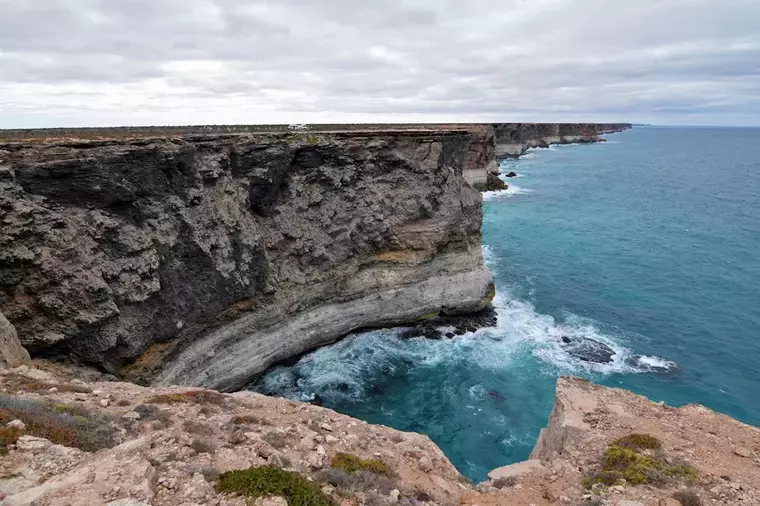
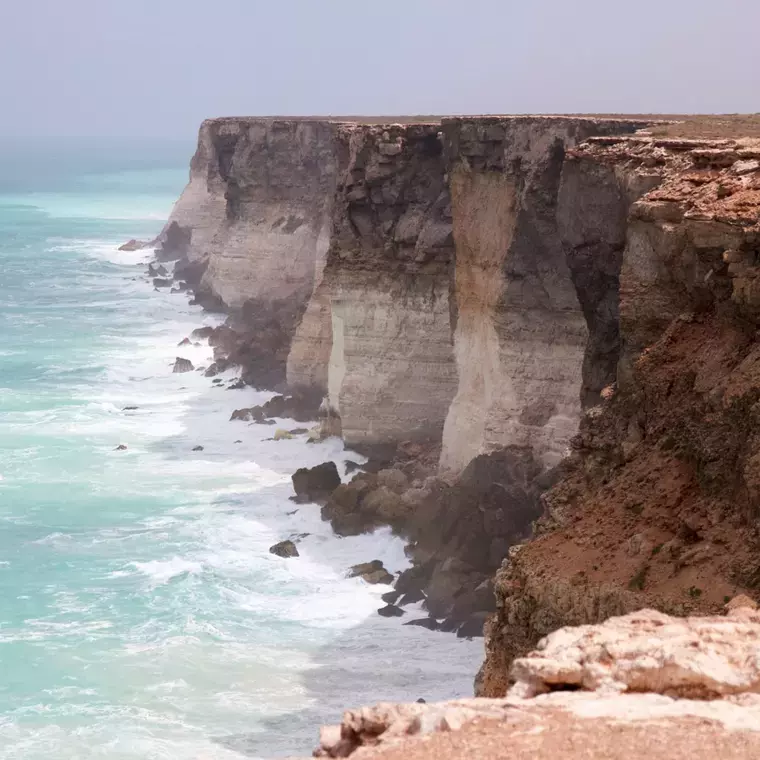
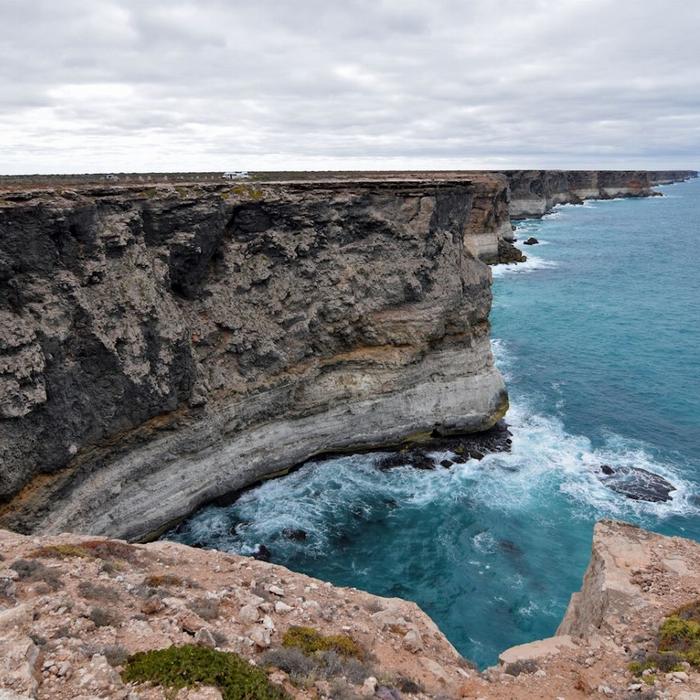
Cross the border into South Australia and stop at the Bunda Cliffs, where the plain ends in a sheer limestone wall dropping into the Great Australian Bight. It feels like the edge of the world. Near the end of the Nullarbor, Cactus Beach is a famous surf break for experienced surfers only, but anyone can watch from the dunes. Nearby, the road runs between two lakes, one pink and one blue. Finish at Ceduna, the heart of South Australia's oyster country, where you can try the seafood or throw in a line.
DAYS 14-15: THE EYRE PENINSULA
Take your time down the west coast of the Eyre Peninsula. At Venus Bay, a small fishing village on a sheltered bay, the clifftop lookouts face straight into the Southern Ocean. Talia Caves are hollows the sea has carved into the cliffs, and you can walk down into the largest, the Woolshed. Greenly Beach has rock pools that fill and spill with every wave, perfect for a dip on a calm day. Push on to Coffin Bay National Park if there's time, or set up camp nearby and save it for the next morning.
DAY 16: COFFIN BAY NATIONAL PARK
Coffin Bay National Park was named in 1802 by Matthew Flinders after his friend Sir Isaac Coffin, a naval commissioner. Look out over Point Avoid, walk the wide sweep of Almonta Beach, take in Golden Island offshore and swim in the calm water at Yangie Bay. Afterwards, head to Port Lincoln, home of Australia's southern bluefin tuna fleet, to try or catch some fresh seafood. In the afternoon, drive a few hours towards Adelaide, with beaches on the eastern side of the peninsula to camp beside.
DAY 17: ADELAIDE AND THE BAROSSA
Head for Adelaide, with a few options for hikes or beaches on the way. Laid out in 1837 by Colonel William Light, it is a city entirely ringed by parkland. Spend a few hours in town, or go straight to the Barossa Valley, settled in the 1840s by German-speaking Lutherans who planted some of the first vines, for wine tastings at cellar doors that have been in some families for generations.
DAY 18: ROBE
Your first stop out of Adelaide is Robe, a seaside town that is a fisherman's paradise. In 1857 thousands of Chinese gold seekers landed here and walked hundreds of kilometres to the Victorian goldfields, to avoid the tax Victoria charged at its own ports. Today you can soak up the sun on one of its many white sandy beaches before setting up camp for the night.
Overnight: Robe
DAY 19: MOUNT GAMBIER
Spend a day in Mount Gambier, a town built on the slopes of an extinct volcano. Its crater holds the Blue Lake, which turns a vivid cobalt blue each year from about November to March. In town, the Umpherston Sinkhole is a collapsed limestone cave turned into a sunken garden by James Umpherston in 1886, and the Cave Gardens are another sinkhole right in the town centre. A short drive away is Tantanoola Caves Conservation Park, a limestone cave full of formations, near the town famous for the "Tantanoola Tiger", a wolf shot there in 1895.
DAYS 20-21: THE GRAMPIANS (GARIWERD)
Spend two days in Gariwerd (the Grampians), a run of tilted sandstone ranges rising out of the Western District plains. Major Thomas Mitchell named them in 1836 after the hills of Scotland. There are waterfalls, mountain hikes and lookouts, wildflowers in spring, and wildlife including echidnas, wallabies and kangaroos. Gariwerd also holds the majority of Victoria's known Aboriginal rock art sites, and you can learn about the Djab Wurrung and Jardwadjali peoples, whose country this is.
DAYS 22-23: THE GREAT OCEAN ROAD TO MELBOURNE
Get up early and drive to Port Fairy, the old whaling town at the western end of the Great Ocean Road, then stop at Warrnambool for information. From there the road was cut along the cliffs by returned First World War soldiers, a memorial to their mates. The famous stops come one after another: the Twelve Apostles, limestone stacks the sea is slowly wearing away; The Razorback; The Grotto; Loch Ard Gorge, where only two people survived the wreck of the Loch Ard in 1878; and London Bridge, which lost its span in 1990. Perhaps go as far as Cape Otway, then on the last day head into Melbourne to finish.
Map



 Pictures / Videos

Reviews