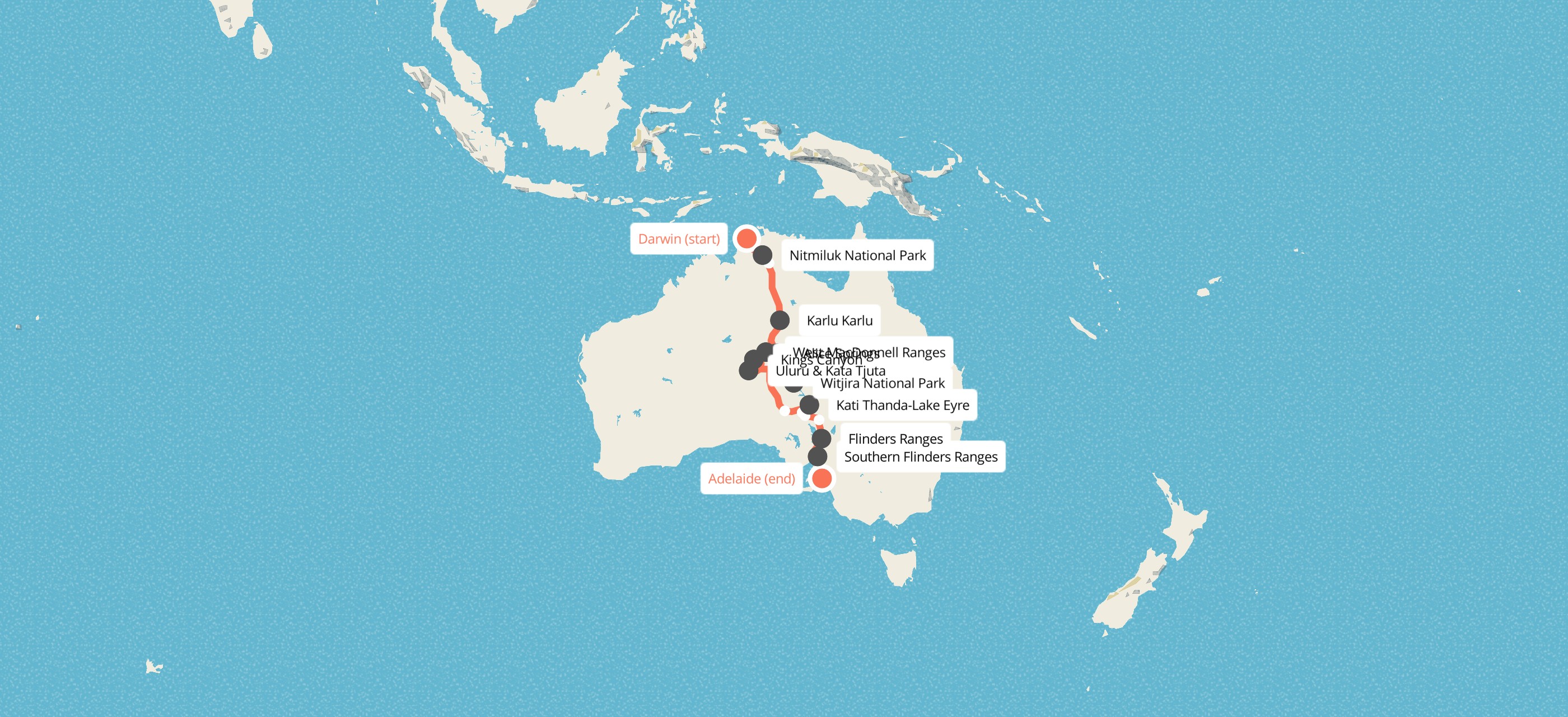
Map
DAY 1: DARWIN TO KATHERINE GORGE
An early pick-up from your Darwin accommodation, then south down the Stuart Highway. At the Adelaide River War Cemetery, the largest war cemetery in Australia, lie servicemen and civilians killed in the bombing of Darwin and the northern campaign of the Second World War. Pine Creek owes its existence to gold, found in 1871 by men digging holes for the Overland Telegraph Line. Lunch and a swim are at Edith Falls (Leliyn), where a waterfall tumbles into a broad pool fringed with pandanus. By evening you reach Nitmiluk (Katherine Gorge), owned by the Jawoyn people.
Overnight: Katherine Gorge (camp)
DAY 2: KATHERINE GORGE AND MATARANKA
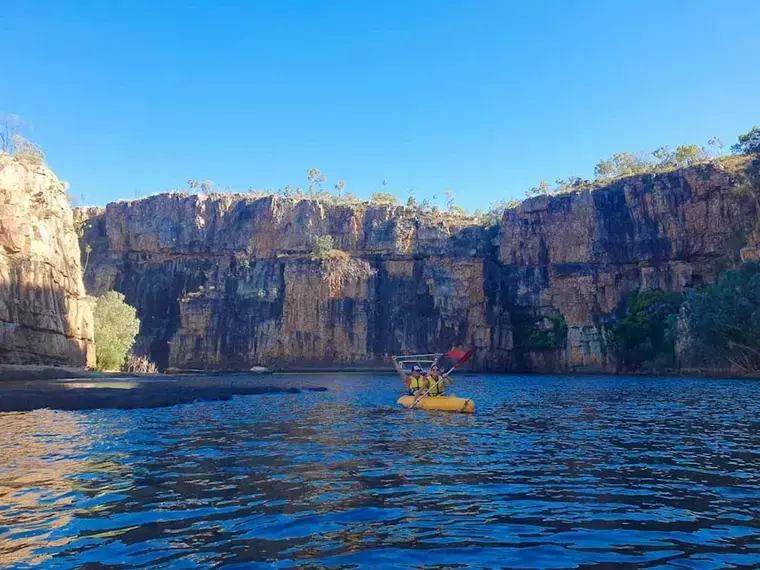
The morning is yours at Nitmiluk, where the Katherine River has cut a chain of 13 gorges through the sandstone. You'll see them from the water, on a cruise or a guided canoe trip, whichever you chose when you booked. In the afternoon you head to Mataranka Hot Springs in Elsey National Park, a clear thermal pool around 34°C shaded by tall Livistona palms. Jeannie Gunn's 1908 book about her year on Elsey Station made this country famous across Australia.
Overnight: Elsey National Park (camp)
DAY 3: BITTER SPRINGS TO KARLU KARLU
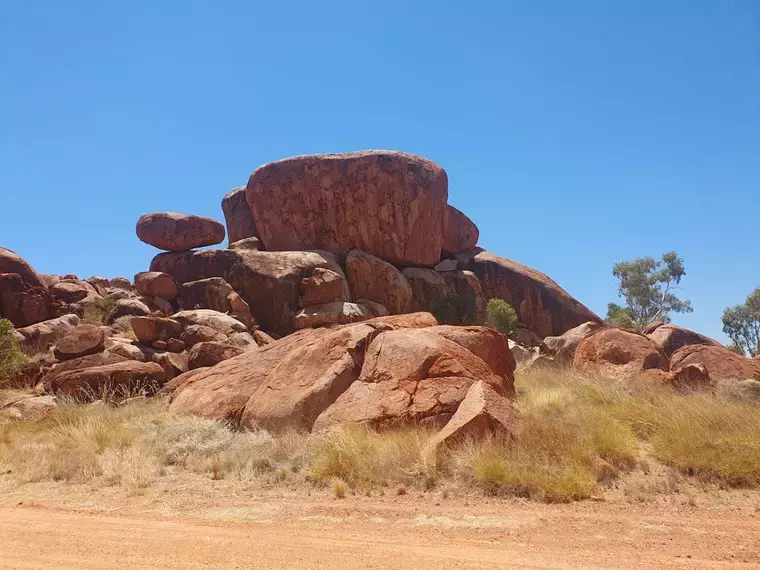
Start the day floating in Bitter Springs, where the warm blue-green water carries you gently through the palms. Then it's a long run south, broken at the Daly Waters pub, whose walls and ceiling are covered in bras, banknotes, caps and number plates left by travellers. By late afternoon you reach Karlu Karlu (Devils Marbles), huge rounded granite boulders, some balanced on others, sacred to the Warumungu, Kaytetye, Alyawarr and Warlpiri peoples. Watch them turn deep red as the sun goes down.
Overnight: Karlu Karlu (camp)
DAY 4: TROPIC OF CAPRICORN TO ALICE SPRINGS
A stop at the Tropic of Capricorn marker on the Stuart Highway, then on to Alice Springs. At the Alice Springs Telegraph Station, built in 1872 on the Overland Telegraph Line, you see where the town began: the waterhole beside it was named after Alice Todd, the wife of the line's builder, Charles Todd. After a lookout over the town, you have free time to wander the shops and Aboriginal art galleries.
DAY 5: THE WEST MACDONNELL RANGES
West of Alice, the West MacDonnell Ranges run for more than 160 km in long red ridges. At Ellery Creek Big Hole a permanent waterhole sits in a gap in the range, cold even on hot days. At Glen Helen Gorge you swim where the Finke River, often called one of the oldest rivers in the world, cuts through the ranges. Then on to Palm Valley, home to red cabbage palms that grow nowhere else on earth, survivors from a time when Central Australia was far wetter. Keep an eye out for rock wallabies on the cliffs.
DAY 6: KINGS CANYON
An early start for Watarrka National Park and Kings Canyon, whose sandstone walls rise more than 100 metres above the creek. You spend most of the day here, walking the rim above the main gorge and dropping into the Garden of Eden, a permanent waterhole where cycads and ferns grow in the shade. In the afternoon you continue to Uluru-Kata Tjuta National Park.
DAY 7: ULURU AND KATA TJUTA
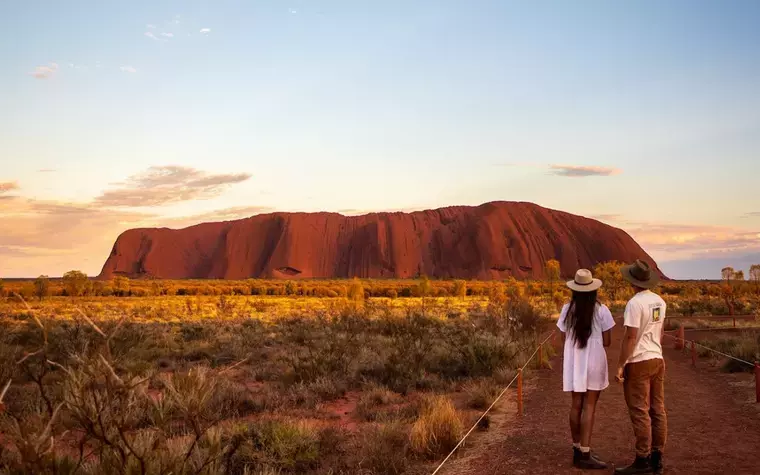
Up before dawn to watch the sun rise over Uluru, which stands 348 metres above the plain. Your guide then leads the base walk, past rock art and Anangu cultural sites, explaining the stories behind them. A short drive brings you to Kata Tjuta, a group of 36 domes whose tallest, Mount Olga, is about 200 metres higher than Uluru. In the evening you're back for sunset, as Uluru's colour shifts from orange to deep red.
DAY 8: THE REMOTE CENTRE
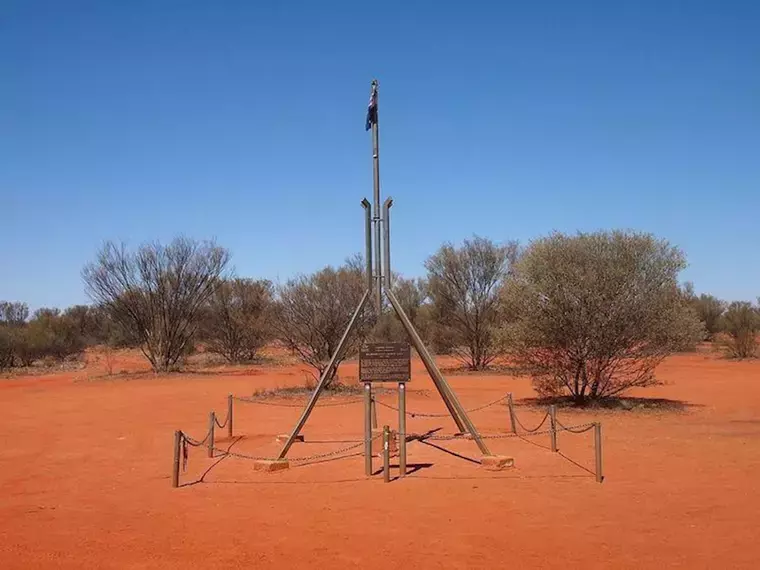
Today you leave the bitumen for the old Ghan country. Aputula (Finke) grew up as a siding on the original Ghan railway line. At the Lambert Centre, the geographic centre of mainland Australia, a small replica of the Parliament House flagpole marks the spot. At Charlotte Waters you see the ruins of an Overland Telegraph repeater station from the 1870s, out in country where the nearest town is hundreds of kilometres away.
DAY 9: WITJIRA NATIONAL PARK
At Mount Dare, a remote pub on the edge of the Simpson Desert, you refuel before crossing into Witjira National Park. Opossum Waterhole draws birds and other wildlife, and the date palms beside the ruins of the old Dalhousie station were planted by early settlers. The highlight is Dalhousie Springs, a cluster of artesian springs where warm water rises from the Great Artesian Basin into a large pool fit for a long soak. The day's drive crosses the red dunes of the Pedirka Desert.
DAY 10: OODNADATTA TO COOBER PEDY
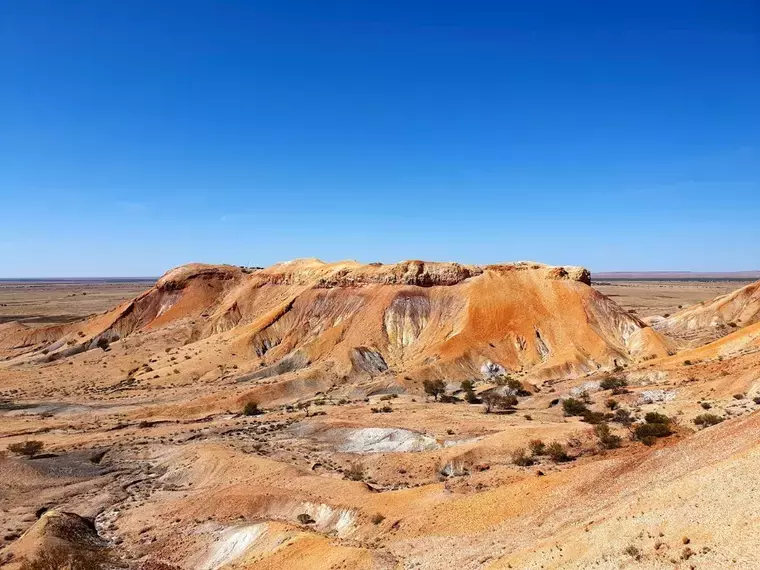
Oodnadatta recorded 50.7°C in 1960, for decades Australia's highest official temperature. Next comes the Painted Desert, where eroded hills are banded in white, yellow, orange and red. In Coober Pedy you get a lesson in opal mining and a tour of a working mine; the town produces much of the world's opal, and many locals live underground to escape the heat. You also see the Dingo Fence, over 5,000 km long and one of the longest fences in the world.
Overnight: Station country (camp)
DAY 11: LAKE EYRE COUNTRY
Today you pass through Anna Creek Station, the largest working cattle station in the world, bigger than some countries. For an extra cost, a scenic flight takes you over Kati Thanda (Lake Eyre), Strangways Springs and the old Ghan sidings. On the ground, Blanche Cup is a mound spring where tiny desert gobies live in water that has travelled underground for thousands of years. At Coward Springs, an old Ghan railway siding, you swim in a natural spring-fed pool. Then you stand at the edge of Kati Thanda, about 15 metres below sea level and the lowest point in Australia.
DAY 12: MARREE TO THE FLINDERS RANGES
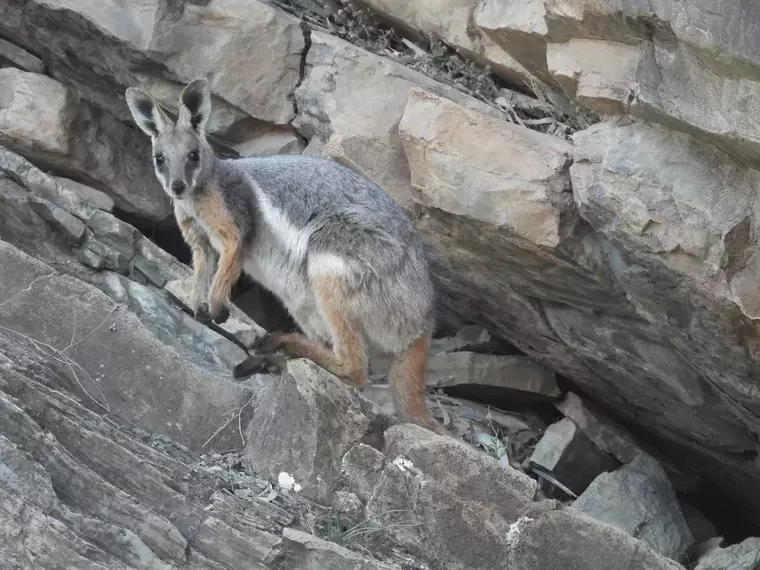
Marree sits where the Oodnadatta and Birdsville tracks meet, and its yacht club, in a town hundreds of kilometres from the sea, raises a laugh. South of town you stop at colourful ochre cliffs, ochre that Aboriginal people have prized and traded for generations. Then the land rises into the Flinders Ranges, where fossils in the Ediacara Hills gave their name to a whole period of the earth's history. You drive through Brachina Gorge, home to rare yellow-footed rock-wallabies, and Bunyeroo Gorge, with layers of rock hundreds of millions of years old.
DAY 13: FLINDERS RANGES TO ADELAIDE
The last morning takes in Razorback Ridge and Wilpena Pound (Ikara), a huge natural amphitheatre of mountains about 17 km long. Your guide takes you to an Adnyamathanha painting and ceremonial site, before the drive south through Quorn, where the old Ghan line began its run north. The tour finishes at the Ibis hotel on Grenfell Street in the centre of Adelaide.
Map




 Pictures / Videos

Reviews